

How To Repair Jewelry That Is Stripped Of Lacquer
The moon over Zhuxi
I gaze out the window of a seminar room where masters and officials are discussing the current land of lacquer fine art. The full moon rises higher up the mountains of Zhuxi. Information technology silhouettes the trees whose resin is extracted at night to produce some of the finest lacquer in China. Meanwhile, inside, a lacquer main with a wispy beard complains near the prevalence of artificial lacquer in the market place. Equally the honored guest, I am permitted a question: "How do y'all tell the difference betwixt artificial and real lacquer?" Everyone smiles: trust a foreigner to be and then blunt. The response to my question is adamant: "Only the primary knows!"
After the forum, over a peculiarly tasty soup of bamboo peel, I raise this question with my immature translator. She whispers the answer to my question: "Darkness is indispensable to capeesh lacquer." She'southward quoting Jun'ichirō Tanizaki's classic, In Praise of Shadows.
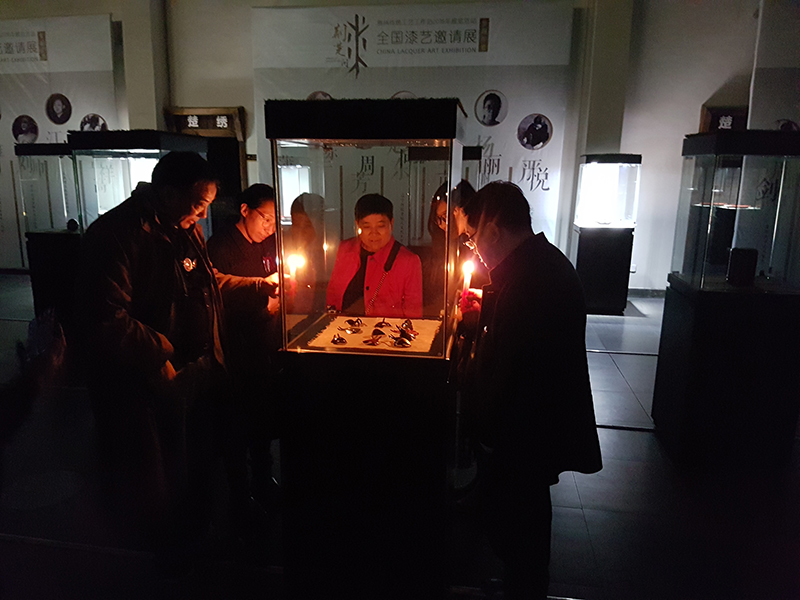
Perfect. We determine that the subtle huī guāng, or glow, of real lacquer might exist all-time appreciated not in the bright lights of a gallery, but by candlelight. The organizers embrace our proposition enthusiastically and a nocturnal tour of the exhibition is speedily organized. Property a flickering candle, the master guides u.s.a. through the gallery. The objects practise indeed sparkle and take on a special aura, similar nocturnal creatures creeping out under the moonlight. This is the experience of "real" lacquer.
Lacquer in jewelry art
Lacquer is a challenging textile for contemporary jewelry. It doesn't fit comfortably in the modernist framework. Lacquer is neither precious metal nor stone, nor a magically repurposed everyday substance similar packaging.
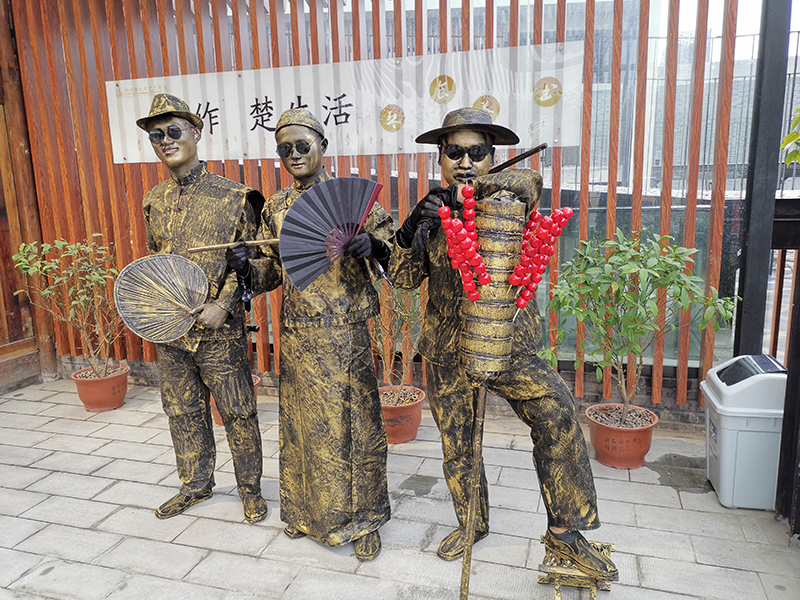
I've been to two Cathay Lacquer Alliance summits in Jingzhou, Hubei Province. They are dazzlingly ambitious events. The terminal one unveiled plans for a "lacquer city" to be built in the following year (presumably deferred for now due to the coronavirus outbreak). My eyes have been opened to this ancient substance. Lacquer adds a radiance to the objects information technology coats, imbuing them with a glow like that of salubrious human skin. Merely information technology also tells us something about the cultures of East Asia that are currently reviving this technique. They have an important lesson to teach us about the verse of objects.
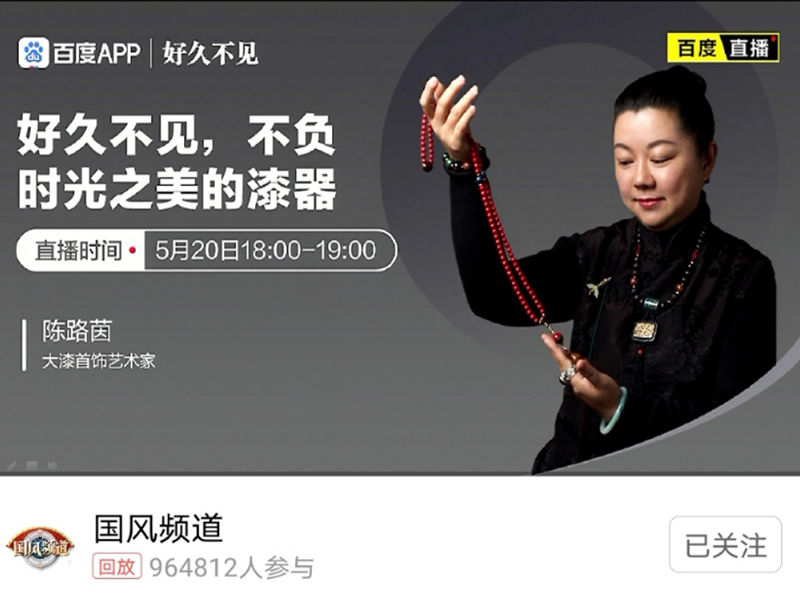
To understand the power of lacquer in China today, consider the jewelry of Chen Luyin. A recent graduate of Beijing'south Tsinghua University, she markets her Tang Hulu range as a source of positive emotion. In a recent WeChat conversation, she says that lacquer "shines from the within out" and has a "life-shaking force." This was demonstrated during the pinnacle of the COVID-19 pandemic, when she went live on the Baidu video platform to stage a "passing of love." Ii hundred people participated directly via Baidu chat on the pop Guofeng Channel, while nearly a million viewers watched as she discussed her work for over an hour. Her lacquer jewelry was offered for auction at cost.
Why name her series Tang—as in the majestic dynasty of Communist china? In talking about the item Chinese approach to lacquer, my translator referred to the concept of wù gǎn, which loosely translates as "the feeling of the object." This contrasts with the Western mode of viewing objects through the lens of subjective values, such as a personal sense of beauty, personal memory, or luxury. According to wù gǎn, it'southward the objects themselves that create the feeling. This is particularly evident in the poetry of the Tang dynasty, which alludes to emotions heightened in moonlight. Thus the Tang poet Zhang Jiuling conjures a wistful scene:
Over the sea grows the moon bright;
Nosotros gaze on it far, far apart.
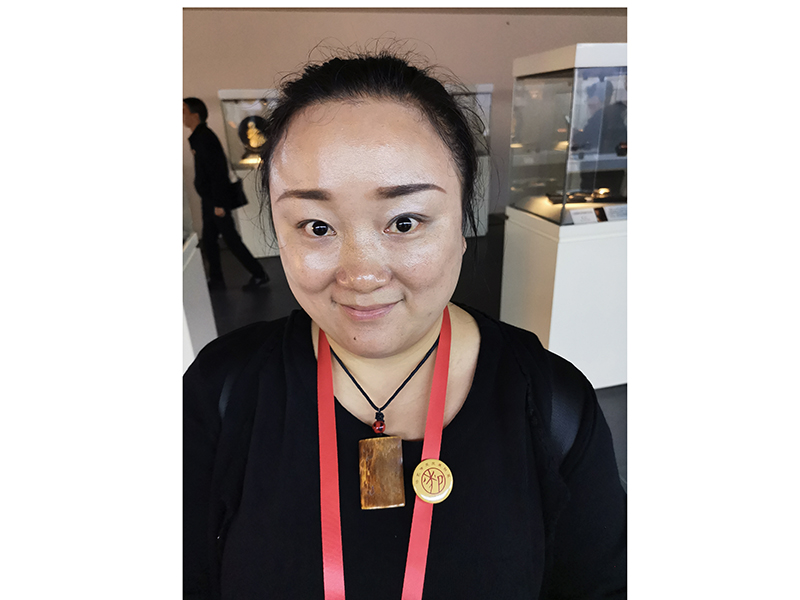
This meditative sensibility was as well reflected in the pendant worn by some attendees, which consisted of a obviously foursquare of bone that had been covered in lacquer. This wu shi pai is used by Daoist scholars to contemplate pettiness.
Currently, lacquer is caught up in the revival of ancient culture in China, forth with traditional dance, music, and sinewy Han costume. Like much else in the Middle Kingdom these days, it'southward produced for local consumption and unlikely to take broad appeal internationally. But their rediscovery of lacquer has broad relevance.
Japan, where lacquer is the "real matter"
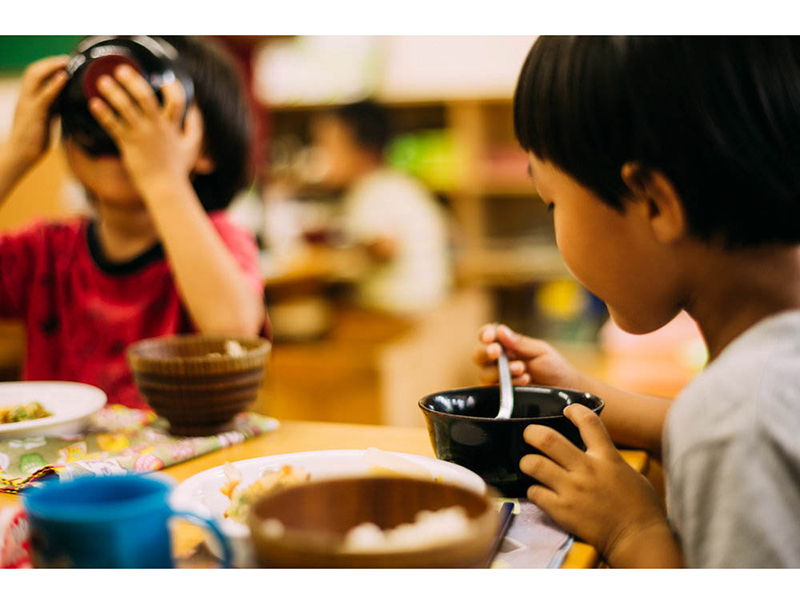
Lacquer takes on boosted significant when we move across the ocean to Japan. Takuya Tsutsumi is an urushi (lacquer) refiner for Tsutsumi Asakichi-ten, a fourth-generation supplier of lacquer. Tsutsumi initiates projects that introduce lacquer to everyday life. The Urushi no Ippo [i] project provides wooden lacquer Hino bowls to kindergartens so that children gain a deep understanding of the dazzler of lacquer from an early on age. Tsutsumi has even traveled to Australia in social club to assistance make a lacquered surfboard that reflects the beauty of the sun and the h2o.[2]
Foreigners who are serious about lacquer make a pilgrimage to the Japanese hamlet of Wajima to be initiated into its difficult mysteries. The Dutch restorer Dave van Gompel reflects on the almost spiritual response to the painful allergies and severe itching that well-nigh feel when first working with the substance:
Equally I went through many sleepless nights to the signal where the skin from my wrists was falling off, my instructor took me past the manus and reassuringly told me: "The Lacquer God is trying to connect with yous. End resisting and yous volition exist fine."[iii]
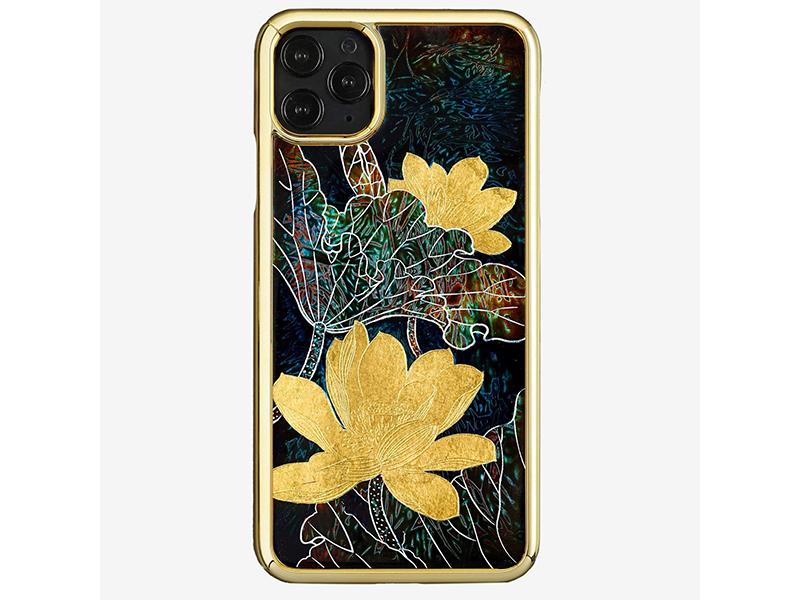
But equally the Chinese masters do, Gompel makes a sharp distinction between the real and false qualities of objects. Lacquer items are classified as honmono—"the real thing." Introducing these honmono into everyday life reflects the philosophy of "living craft," as epitomized by the tea ceremony. No doubt the well-nigh ubiquitous example of this in daily usage today is the nail salons that have proliferated in the West. While they may not use urushi, they reflect the allure of an intricate numinous surface at hand. And that carefully clean-cut mitt can in plow hold ane of the principal outlets for lacquer art—the smartphone case. The Vietnamese studio La Sonmai[4] produces exquisite unique cases that highlight the dazzling color of lacquer.
The natural verse of Japanese contemporary jewelry
At that place are many Japanese contemporary jewelers working in lacquer. Michihiro Sato'southward Possession contrasts the milky glow of lacquer with the crisp color of paper, in parallel with the relationship between flower and leaf.
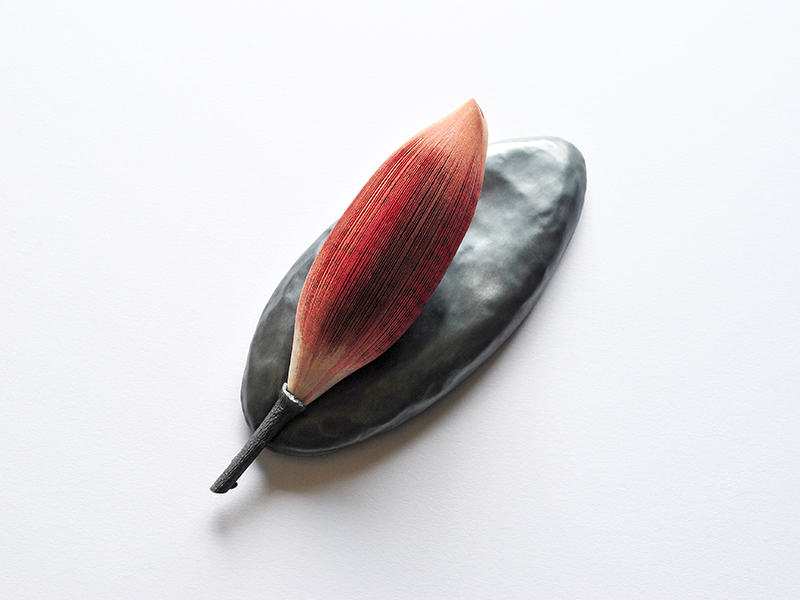
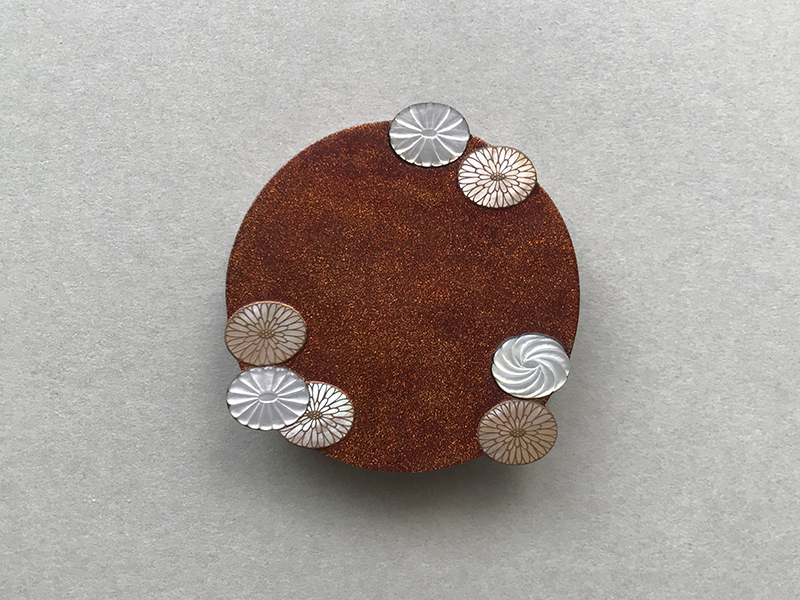
Another creative person, Saya Yamagishi, also uses lacquer to evoke the wonder of nature. Her piece of work takes a variety of forms, including objects, pin brooches, and hairpins. The Chrysanthemum Brooch demonstrates the rich texture created through the makiye technique, where gold grit is delicately sprinkled onto lacquer.
Relative to plastics, lacquer proves an enduring substance that preserves ancient artifacts. This quality is used poetically past Kimiaki Kageyama with a serial of rings covered with lacquer fragments from a Japanese shrine. This reflects the kintsugi aesthetic, which focuses on the beauty of repair.
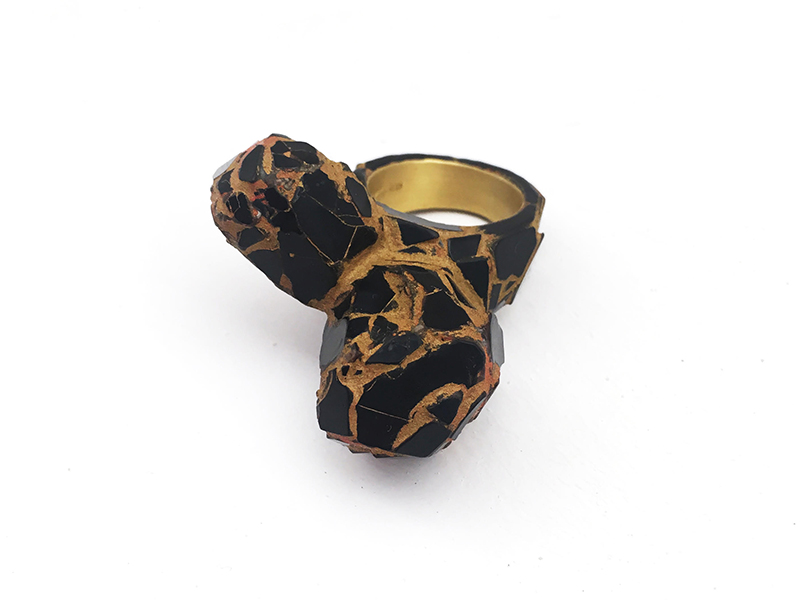
Lacquer demands an expansion of our critical framework for gimmicky jewelry, which tends to approach works through the biography of the maker. We might normally enquire: How does the work express the artist's identity or experiences, such as working with materials on the demote? In the case of lacquer, we need to reverse the perspective. In a way like to New Materialism, we tin instead view these works through the lens of wù gǎn, as vehicles for the feeling of lacquer to be transmitted. This feeling is itself amorphous and requires a poetic framework to requite it meaning, such every bit the wistfulness of Tang poetry or the enchantment of nature in some Japanese works.
The lacquer diaspora
It's rare to observe lacquer used in the Westward. But Australia, a Western land in the Eastern hemisphere, sometimes produces hybrid cultural forms.
Bic Tieu's grandparents moved from Mainland china to Vietnam to escape poverty, and then her parents left Southward Vietnam for Australia for similar reasons later the state of war. Her involvement in lacquer began with the pearl-inlaid lacquer panels that her family brought back from visits to Vietnam. Driven to learn this technique herself, she, as well, traveled to Wajima and studied with lacquer master Kitamura Tatsuo.
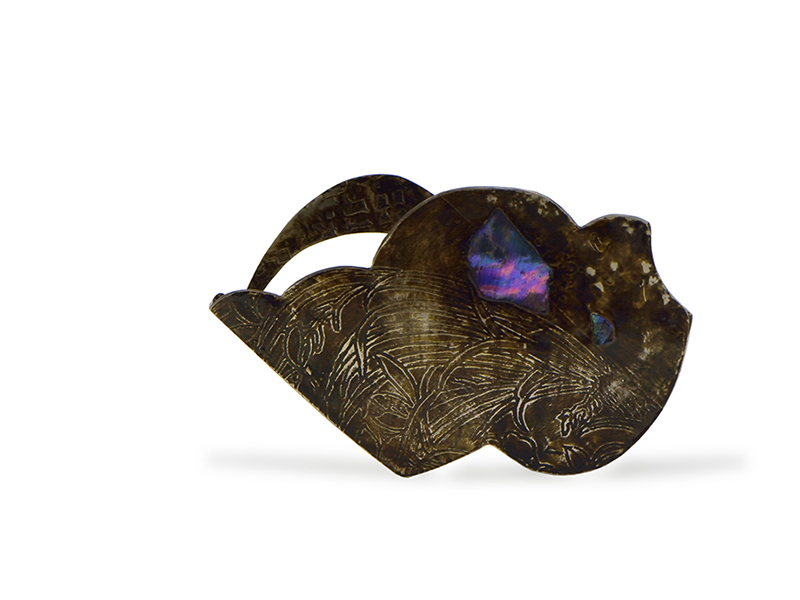
Since so, Tieu'due south jewelry work has used the language of lacquer to reflect on the experience of migration. This is oftentimes narrative-based, such as the Moon Low-cal Sea series, which depicts her parents' original journey. The boat-like class is etched in silverish with peonies, featuring mother-of-pearl. Unlike the traditional forms typically used in lacquer work, Tieu's motifs are unfinished and re-sampled, reflecting the feel of living in a mixed civilisation. She inevitably returns to Due east Asian cultural designs to tell her story.
Beyond lacquer?
The Eastern techniques and narratives of lacquer play an important role in contemporary jewelry. The slowness of its processes, and its connection with nature and long life, imbue information technology with an aureola that is appreciated particularly at a time when we're aware of the limits of speed and evolution.
It may seem problematic that its use is articulated through specifically Asian cultural identity. This is at odds with the modernist approach to materials, which ascribes a universal truth to their concrete being. Information technology'southward besides at variance with the school of New Materialism, which projects agency onto nonhuman substances equally something outside our capacity to sympathize.
The influence of chinoiserie in Western decorative arts indicates an indelible fascination for Chinese culture, but unless a poetics of lacquer develops in the West, it'due south likely to remain an Eastern material. This cultural abstraction is cardinal to the concept of wù gǎn.
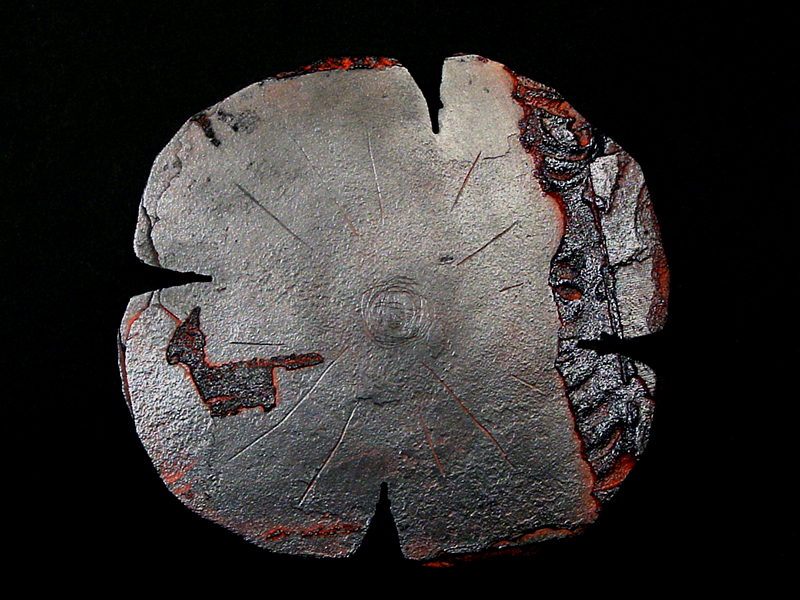
Equally with the Confucian concept of li, reality is inevitably experienced through a cultural lens, particularly in ritual and poetry. Beyond lacquer, we could take this lens to other materials that have caused cultural resonances in the Westward, such as silverish or gilded. Information technology can help us appreciate jewelry artists similar Margaret Due west, who sought to articulate a poetry of materials such as lead and stone.
At the moment, lacquer appears to be a particularly Eastern cloth, in practise and meaning. It's intriguing to question whether this is inevitable or an blow of history. The claiming of forging a new verse of lacquer awaits.
[i] https://www.urushinoippo.com/
[two] Read near it on https://garlandmag.com/article/urushi-surf/.
[3] https://garlandmag.com/loop/lacquer-god/.
[four] https://lasonmai.com/

How To Repair Jewelry That Is Stripped Of Lacquer,
Source: https://artjewelryforum.org/articles/lacquer-rises-in-the-east/
Posted by: michaudhimentrapsed00.blogspot.com
0 Response to "How To Repair Jewelry That Is Stripped Of Lacquer"
Post a Comment