 Panelmount Cables and Wall Plates
 This guide is meant to give a general overview to This guide is meant to give a general overview to
the process of installing DataPro face plates and
panel-mount cables in a dwelling or role setting. It
is by no means an installation guide, and all
installing should be done by a licensed technician. - Running the Wiring
- Installing the Wall Plates
- Mounting the Cables
- Finishing Touches
- Boosting USB Signals
- FireWire and DVI Limitations
- Using Spliced VGA Cables Back to the Plates & Cables Home
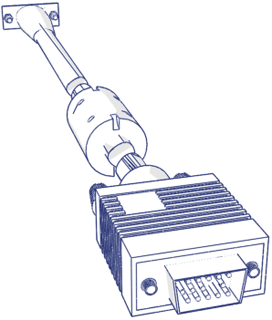 Depending on the length and location of your run, getting the cabling end to end can be a v-minute or all-day job. Try to minimize the number of turns and drill holes by locating plates between the same studs or nearby existing wiring plates (i.e. phone lines). Depending on the length and location of your run, getting the cabling end to end can be a v-minute or all-day job. Try to minimize the number of turns and drill holes by locating plates between the same studs or nearby existing wiring plates (i.e. phone lines). For USB cables, which run only 15 feet and must be connected to booster cables, it is best to secure the splices with tape or other adhesive. USB cables do non accept mating screws and might disconnect during the installation or later on. Read more for data on extended USB runs. For VGA cables, the best method is a spliced (not-terminated) cablevision that runs through a hole much smaller than the VGA hood. We stock a full line of non-terminated VGA cables ideal for installations. Information technology is strongly recommended that these cables are pulled with a lead and non direct from the round 8-pin Din connector, equally this may strain the wires and could potentially damage the cablevision. Read more for information on not-term and spliced VGA cables.
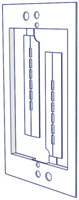 There are 5 basic methods for mounting our standard wall plates, depending on the surface and type of connexion. The simplest is but the plate itself, which can be mounted with screws directly into a solid supportive wall similar wood or metal. For less structural surfaces, like plaster or drywall, a mounting subclass is recommended to strengthen the attachment points. When affixing a mounting bracket to a wall, finding a stud is not required—merely cut a hole, sideslip the bracket in place, and tighten the wing clamps. These not-conductive plastic frames are durable and easy to install, adjustable for mounting in a surface betwixt one/4" and 1" thick. The face up plate can then be mounted to the bracket for a potent, sturdy connection. The next great mounting pick is accomplished by using a in-wall mounting box. This durable box must be screwed to a stud, which provides a structurally stable in-wall enclosure. When affixing a box, ane must first observe a stud then cut an opening adjoining the stud, skid the box in place and secure with screws. The advantages to using the box include: you lot tin mate the box to standard electric conduit; your wire terminations volition always exist conveniently available inside the box; and a box screwed to a stud is the about secure mounting. 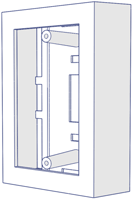 For surfaces which are hard to drill or cut into, such as concrete or brick, a surface-mount box provides a clean solution. These can mount onto the wall with screws or the provided adhesive, and a standard face up plate can attach directly to the forepart. They provide an inch and a half of clearance for connectors behind the plate, and cables can be run through the gap in the back or through a hole drilled into the plastic sides. For surfaces which are hard to drill or cut into, such as concrete or brick, a surface-mount box provides a clean solution. These can mount onto the wall with screws or the provided adhesive, and a standard face up plate can attach directly to the forepart. They provide an inch and a half of clearance for connectors behind the plate, and cables can be run through the gap in the back or through a hole drilled into the plastic sides. 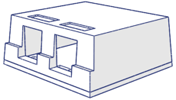 Keystone connectors tin can as well exist used in smaller keystone surface boxes that are a discreet way to add network and telephone connections without installing additional plates. At merely and inch high and just over two inches deep, we offer one-port and ii-port boxes that tin exist customized with any of our Keystone uniform connectors. Keystone connectors tin can as well exist used in smaller keystone surface boxes that are a discreet way to add network and telephone connections without installing additional plates. At merely and inch high and just over two inches deep, we offer one-port and ii-port boxes that tin exist customized with any of our Keystone uniform connectors.
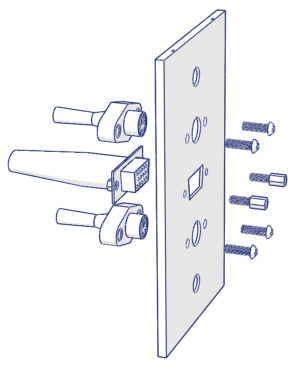
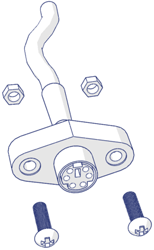 All of our console-mount and mountable cables are designed for an like shooting fish in a barrel, no-hassle connexion to the plates. Every console-mount cable includes mounting screws that match the cutout on the plates, and attach straight in a matter of seconds. Cables that have mating screws, such as VGA and DVI, are provided with hex-nut screws that also adhere through the holes in the plate, to allow the external cables to screw in securely. If you are using Keystone connectors, they easily snap into the Keystone plug on the plate and receive the matching wire on the within. All of our console-mount and mountable cables are designed for an like shooting fish in a barrel, no-hassle connexion to the plates. Every console-mount cable includes mounting screws that match the cutout on the plates, and attach straight in a matter of seconds. Cables that have mating screws, such as VGA and DVI, are provided with hex-nut screws that also adhere through the holes in the plate, to allow the external cables to screw in securely. If you are using Keystone connectors, they easily snap into the Keystone plug on the plate and receive the matching wire on the within. If you cull not to buy a panel-mount or mountable cable, or already have existing terminated cables that y'all would similar to mount, information technology is also possible to attach couplers into the face plates for a slim splice. We strongly discourage the employ of couplers, because every connexion causes indicate loss and noise interference, especially on high-throughput signals similar VGA, USB, and DVI. 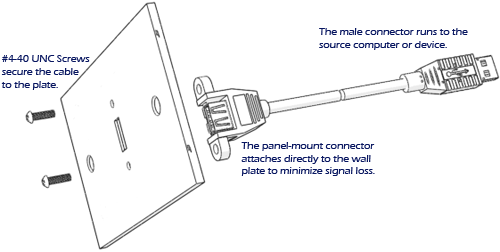
To complete the cable installation, first make certain to exam all wiring before securing the plates and putting tools abroad. Internal connections that don't accept mating screws, similar USB, should exist taped or otherwise secured to forestall slippage. Self-terminated plugs should ever exist tested earlier the plates are fully installed. And although some connectors (like RJ11, CAT5e, and RCA) are offered in a multifariousness of colors, others (similar USB, PS2, and VGA) are not, and having multiple ports on the same plate can be confusing. Information technology is often a good idea to identify the ports with some course of agglutinative label or diagram.
One of the biggest obstacles encountered in planning a wire run is the point limitation of Universal Serial Omnibus (USB). With a maximum guaranteed length of only 16 feet, very few USB runs are successful without the use of Active USB Booster Cables. These are extension cables which feature a booster-box on the female person end that refreshes the USB output, providing and additional fifteen feet of signal. These extensions are chainable, and when strung together tin can accomplish a new maximum of up to 80 feet. Without the use of boosters, we accept successfully run USB upwards to 31 anxiety, but but with high-grade devices. With lower quality products, we've lost bespeak at less than xx anxiety. 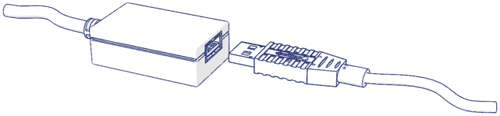 The first central to constructive pattern is to make sure that, over the span of your whole run, there is never any stretch of cable over 16 feet. This ways from computer to booster, booster to booster, and booster to device; each should be no more than 16 feet. The first central to constructive pattern is to make sure that, over the span of your whole run, there is never any stretch of cable over 16 feet. This ways from computer to booster, booster to booster, and booster to device; each should be no more than 16 feet. The other crucial element of effective pattern is to exist aware that the female stop of the active booster, which houses the booster box, must be on the device side of the run, with the male end pointing towards the computer. Because these are powered from the computer'south USB controller, they volition not function when oriented the other mode.
Unfortunately, USB is not the but type of cable with signal limitations. FireWire and DVI also suffer from the 16 foot maximum, and are harder to extend than USB. With potent devices, FireWire has been known to run longer, only is non guaranteed. DVI is much less reliable at even 30 feet, and requires more expensive solutions. FireWire boosting is possible through the utilize of FireWire repeater cables, which offer the convenience and low toll of inline booster cables, but are yet highly effective. Our in-house tests take successfully run over one hundred feet with a single firewire booster cablevision, just individual results may vary. DVI has a specified digital maximum of xx feet, although similar USB and FireWire, this is an elastic number and tin often work at twice that (with good equipment). For longer range runs, extending even further is possible through the use of inline boosters. These are not booster cables like USB has, but rather externally powered repeater boxes. Because they require a ability supply, these are less convenient to install, and are besides quite expensive. The cheapest way to extend DVI is to use an analog signal, from DVI-A or DVI-I, and convert it to VGA. High-course coax VGA wire can run over 200 feet with merely minimal loss, merely you will sacrifice the benefits of the digital video bespeak. If you'd like to maintain a digital video signal for a longer run, the best method is to use an inline DVI repeater booster. This is a small powered box that will clean and dilate an incoming DVI signal for strong image fidelity at up to 75 feet. Because it requires an external power supply, this solution is not always the near feasible, but it is the only reliable style to maintain a fully digital signal at long lengths.
For video installations, we recommend using DVI for any run under 16 feet and VGA for any run above that. Our VGA wires all apply mini-coaxial cables to maximize shielding and forbid noise and ghosting up to and over 200 anxiety, and are bachelor in custom lengths for just what you need. 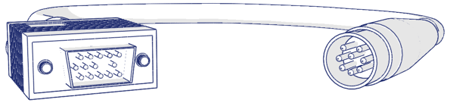 For improved flexibility, nosotros congenital special VGA cables in a non-terminated fashion then that the wire tin can be run through holes smaller than a VGA connector. Using an viii-pivot Din splice, our Not-Term cables sideslip easily through holes just 5/8" in bore, and terminating crimp-pins is non required. When the length of wire has been pulled, the spliced stop is matched with a VGA pigtail of the appropriate gender, and the installation is complete. Bachelor in any length and whatsoever gender combination. For improved flexibility, nosotros congenital special VGA cables in a non-terminated fashion then that the wire tin can be run through holes smaller than a VGA connector. Using an viii-pivot Din splice, our Not-Term cables sideslip easily through holes just 5/8" in bore, and terminating crimp-pins is non required. When the length of wire has been pulled, the spliced stop is matched with a VGA pigtail of the appropriate gender, and the installation is complete. Bachelor in any length and whatsoever gender combination.
Written by DataPro International Inc.
Unauthorized duplication strictly prohibited. | |



0 Response to "How To Install Cable Access Wall Plate"
Post a Comment